Schema Export
Export the active table's column list. Useful for bootstrapping a database table, a Pydantic model, a TypeScript interface, or a Rust struct from real data without re-typing every column name.
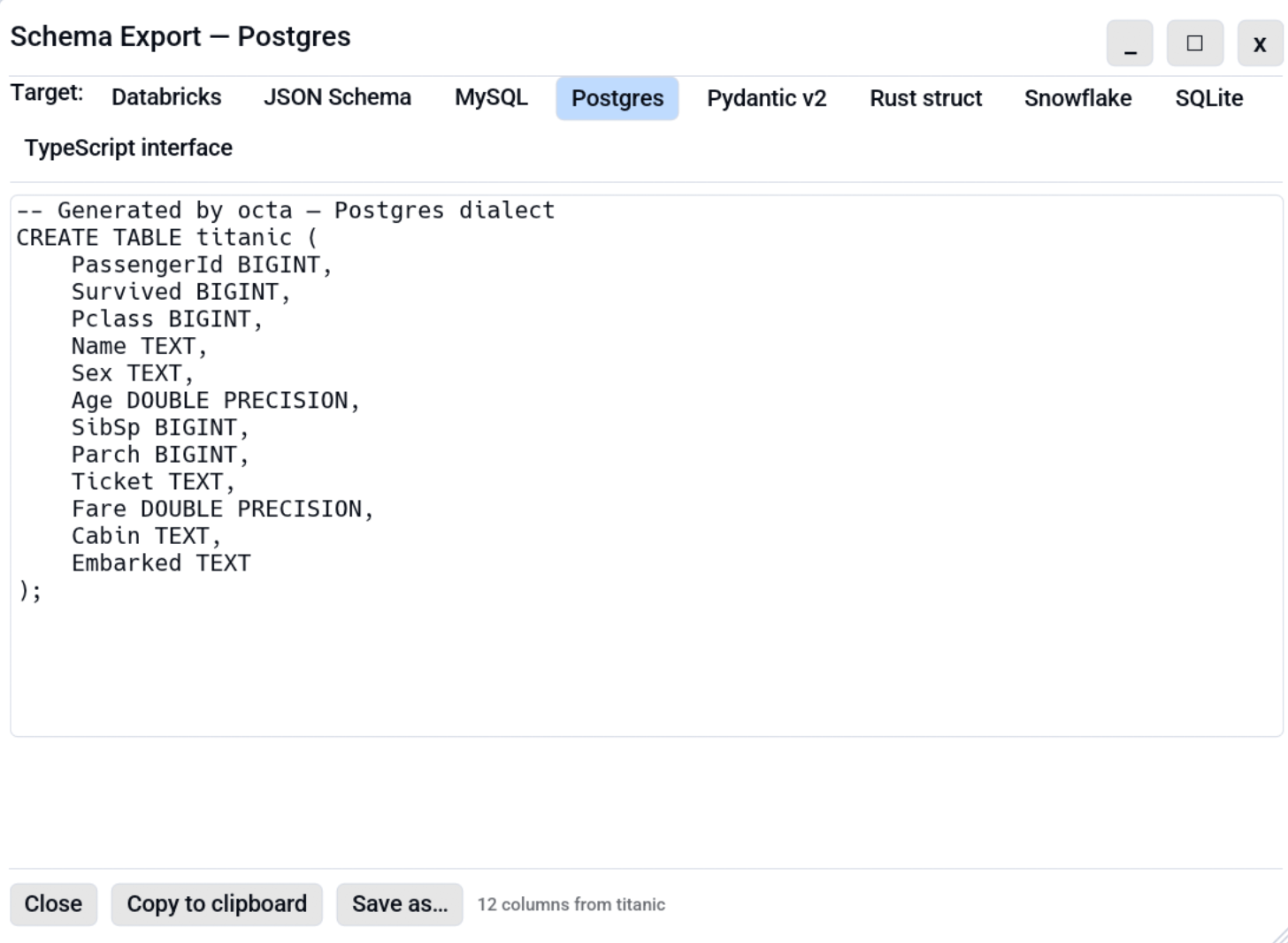
Opening the dialog
| Path | Notes |
|---|---|
| Menu | File → Export schema… opens the dialog on the first target (Postgres). |
| Keyboard shortcut | F7 (remappable under Settings → Shortcuts). |
The dialog renders all ten targets the same way. Switch between them with the chip row inside the dialog. No need to pick a target up front from a submenu.
Supported targets
The dialog lists targets alphabetically:
| Target | Output | File extension |
|---|---|---|
| Databricks | CREATE TABLE with Spark SQL / Delta types (STRING, TIMESTAMP_NTZ). |
.sql |
| JSON Schema | Draft 2020-12 object schema with properties and required. |
.json |
| MS SQL Server | CREATE TABLE with T-SQL types (NVARCHAR(MAX), BIT, DATETIME2), bracket-quoted. |
.sql |
| MySQL | CREATE TABLE with MySQL types (UNSIGNED / DATETIME / BLOB). |
.sql |
| Postgres | CREATE TABLE with Postgres types. |
.sql |
| Pydantic v2 | BaseModel subclass with annotated fields and the correct datetime / Field imports. |
.py |
| Rust struct | pub struct Foo with #[derive(Debug, Clone, Serialize, Deserialize)] and chrono types. |
.rs |
| Snowflake | CREATE TABLE with Snowflake types (VARCHAR, TIMESTAMP_NTZ). |
.sql |
| SQLite | CREATE TABLE with SQLite affinity types (INTEGER/REAL/TEXT/BLOB). |
.sql |
| TypeScript interface | export interface Foo { … } with number / string / boolean mappings. |
.ts |
Type mapping
Octa stores column types as Arrow-style strings (Int64, Utf8,
Float64, Date32, Timestamp(Microsecond, None), …). Each target
maps them to its closest native type:
| Arrow type | Postgres | MySQL | SQLite | Pydantic | TypeScript | JSON Schema | Rust |
|---|---|---|---|---|---|---|---|
Int8 / Int16 |
SMALLINT |
TINYINT / SMALLINT |
INTEGER |
int |
number |
integer |
i8 / i16 |
Int32 |
INTEGER |
INT |
INTEGER |
int |
number |
integer |
i32 |
Int64 |
BIGINT |
BIGINT |
INTEGER |
int |
number |
integer |
i64 |
UInt8 … UInt32 |
widened up one | UNSIGNED variants |
INTEGER |
int |
number |
integer |
u8 … u32 |
UInt64 |
NUMERIC(20, 0) * |
BIGINT UNSIGNED |
INTEGER |
int |
number |
integer |
u64 |
Float16 / Float32 |
REAL |
FLOAT |
REAL |
float |
number |
number |
f32 |
Float64 |
DOUBLE PRECISION |
DOUBLE |
REAL |
float |
number |
number |
f64 |
Boolean |
BOOLEAN |
BOOLEAN |
INTEGER (0/1) |
bool |
boolean |
boolean |
bool |
Utf8 / LargeUtf8 |
TEXT |
TEXT |
TEXT |
str |
string |
string |
String |
Date32 / Date64 |
DATE |
DATE |
TEXT |
date |
string (ISO date) |
string + format: date |
NaiveDate |
Timestamp(…) |
TIMESTAMP / TIMESTAMPTZ |
DATETIME |
TEXT |
datetime |
string (ISO datetime) |
string + format: date-time |
NaiveDateTime |
Binary / LargeBinary |
BYTEA |
BLOB / LONGBLOB |
BLOB |
bytes |
string (base64) |
string + contentEncoding: base64 |
Vec<u8> |
* Postgres has no unsigned integer; UInt64 round-trips as NUMERIC(20, 0) with a /* … */ note.
The two cloud-warehouse SQL dialects map types as follows:
| Arrow type | Databricks | Snowflake |
|---|---|---|
Int8 / Int16 |
TINYINT / SMALLINT |
TINYINT / SMALLINT |
Int32 |
INT |
INTEGER |
Int64 |
BIGINT |
BIGINT |
UInt8 … UInt32 |
widened up one | widened up one |
UInt64 |
DECIMAL(20, 0) * |
NUMBER(20, 0) * |
Float16 / Float32 |
FLOAT |
FLOAT |
Float64 |
DOUBLE |
FLOAT (64-bit) |
Boolean |
BOOLEAN |
BOOLEAN |
Utf8 / LargeUtf8 |
STRING |
VARCHAR |
Date32 / Date64 |
DATE |
DATE |
Timestamp(…) |
TIMESTAMP_NTZ / TIMESTAMP |
TIMESTAMP_NTZ / TIMESTAMP_TZ |
Binary / LargeBinary |
BINARY |
BINARY |
* Neither dialect has unsigned integers; UInt64 round-trips as a
20-digit decimal with a /* … */ note. The two Timestamp mappings
are the tz-less Arrow timestamp vs. the tz-aware one.
Which of the two you get depends on whether the column's type names a
zone, not on how the reader spelled it. Parquet and Arrow IPC name a
naive timestamp Timestamp(µs), ORC names it plain Timestamp, and
DuckDB names it Timestamp(Microsecond, None); all three are naive and
all three export to the tz-less column. A column that does name a zone
(Timestamp(µs, "Europe/Brussels")) exports to the tz-aware one. The
same mapping produces the CREATE TABLE behind
database write-back, so a table written to a
server gets the same column types this page shows.
MS SQL Server maps types as follows:
| Arrow type | MS SQL Server |
|---|---|
Int8 / Int16 |
SMALLINT |
Int32 |
INT |
Int64 |
BIGINT |
UInt8 … UInt32 |
widened up one |
UInt64 |
NUMERIC(20, 0) * |
Float16 / Float32 |
REAL |
Float64 |
FLOAT |
Boolean |
BIT |
Utf8 / LargeUtf8 |
NVARCHAR(MAX) |
Date32 / Date64 |
DATE |
Timestamp(…) |
DATETIME2 / DATETIMEOFFSET |
Binary / LargeBinary |
VARBINARY(MAX) |
* T-SQL has no unsigned integers either. Identifiers are quoted with
brackets ([column name], an embedded ] doubled), not double quotes.
Arrow types that fall outside the table above (e.g. Decimal256,
List<…>) fall through to each target's TEXT-equivalent with a
/* unknown Arrow type "…" */ (or language-appropriate) comment so
the output is never silently wrong.
Identifier handling
Column names with spaces, hyphens, or leading digits would make invalid identifiers in most targets. Schema Export sanitises:
- SQL DDL: identifiers are emitted bare when they're already
valid. A name with spaces, punctuation, or a leading digit is quoted
(
"name"for Postgres / SQLite / Snowflake,`name`for MySQL / Databricks), with embedded quotes doubled. - Pydantic: invalid identifier names get
_substitution +Field(..., alias="<original>")so JSON round-trip preserves the source key. - TypeScript: invalid keys are wrapped in
"…", which is valid TS for object properties. - JSON Schema: keys are passed through verbatim (JSON allows any string).
- Rust: invalid names get
_substitution +#[serde(rename = "<original>")].
The table-level identifier (used for CREATE TABLE, the class /
interface / struct name) comes from the source file's stem (or
data for an unsaved tab) and is PascalCased for class targets.
Copying and saving
- Copy to clipboard drops the rendered text on the clipboard
ready to paste into a
psql, an editor, or a code review. - Save as… opens the system file picker pre-filled with
<source_name>_schema.<ext>.
The active row filter does not affect schema export. A table with 10M rows and an active filter exports the same DDL as the same table with zero filter.
See also
octa --export-schema: the same feature from the command line.- MCP
export_schematool: the same renderers over MCP, with multi-table support. - Summary: see types and per-column statistics without leaving Octa.
- Saving: for writing back to the same DB.